Sustainable Endoscopy Without the Tradeoffs
A practical approach to reducing environmental impact — without increasing cost, adding workflow burden, or compromising patient care.
What Is Sustainable Endoscopy?
Sustainable endoscopy means reducing the total environmental burden of an endoscopy procedure without increasing cost, adding workflow complexity, or compromising patient care. Sustainability initiatives in healthcare often fail to scale because they introduce higher costs, added workflow complexity, or operational constraints.
If sustainable solutions are too expensive or too complex to implement, they won’t reach enough patients to make a meaningful impact. That’s why Ambu approaches sustainability as a system — not a feature.
Does Sustainable Endoscopy Cost More?
Many healthcare leaders associate sustainability with higher costs because sustainable products have historically been offered as premium alternatives. This creates the perception that environmental benefits require financial tradeoffs.
 The hidden costs of reprocessing endoscopes
Reprocessing endoscopes involves significant hidden costs, including labor, equipment, maintenance, and workflow inefficiencies. In healthcare overall, labor accounts for more than 50% of total expenditures.
Because reprocessing depends heavily on trained staff and dedicated workflows, it adds to one of the most resource-constrained and costly areas of hospital operations — making it difficult to scale efficiently.
Reprocessing is often viewed as the lower-impact option. But in practice, it introduces significant hidden costs:
- Labor-intensive workflows
- Dedicated reprocessing teams
- Capital equipment, maintenance, and downtime
- Water‑ and chemical‑heavy disinfection
- Reprocessing risk and variability
READ MORE: Sustainability in Healthcare: Affordable, Accessible, and Achievable
How Do Bioplastics Reduce Environmental Impact in Medical Devices?
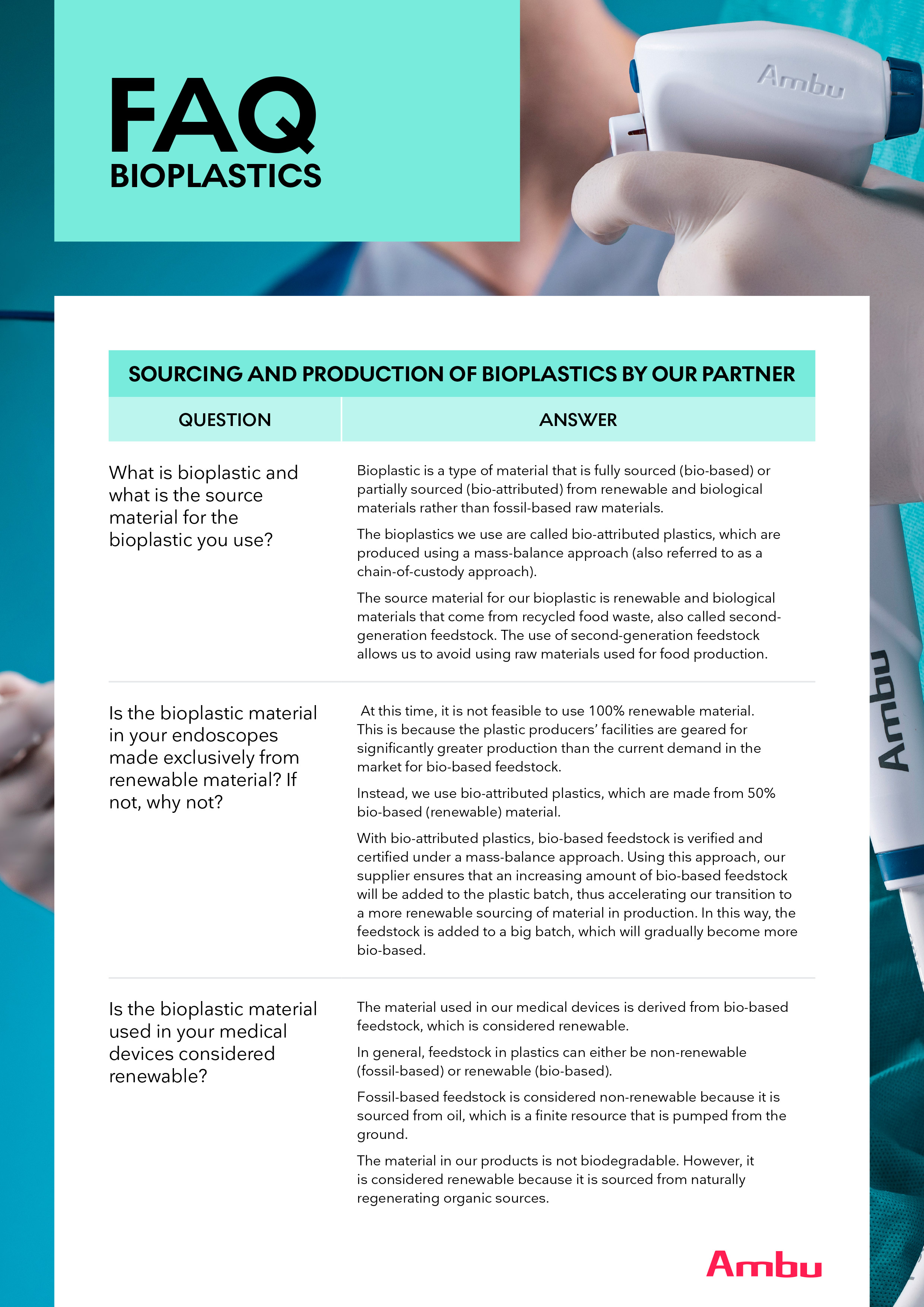 Bioplastics are materials derived from renewable sources that can replace fossil-based plastics in medical devices. They help reduce carbon emissions and environmental impact while maintaining product performance.
The impact of raw materials
Raw materials are one of the largest contributors to emissions in medical devices. Addressing material selection is one of the most effective ways to reduce environmental impact at scale.
In med-tech, raw materials — especially plastics — account for a significant share of total emissions. That’s why Ambu integrates bioplastics across its endoscopy portfolio.
*Ambu internal Life Cycle Assessments (LCAs), ISO 14040/14044–aligned, assessing carbon footprint contribution areas across Ambu single‑use endoscopes.

What Does “Design for Circularity” Mean in Medical Devices?
The impact of product design
Product design determines how materials are used, recovered, and reused. Designing for circularity ensures products can be recycled or repurposed, reducing waste and environmental impact.
Sustainability should be determined during the design phase
Most of a product’s environmental impact is determined during design. Decisions about materials, structure, and recyclability affect emissions, cost, and end-of-life outcomes.
Ambu designs endoscopes with end-of-life in mind, selecting materials that can be recovered and reused, minimizing complexity, and avoiding features that limit recyclability.
READ MORE: Designed for Circularity: Why Sustainability Starts at the Drawing Board

What is Responsible Manufacturing in Healthcare?
Responsible manufacturing in healthcare involves designing production processes that minimize environmental impact while maintaining high product quality.
This includes intentional decisions around energy use, materials, and emissions across global operations.
How does responsible manufacturing impact sustainability in medical devices?
Responsible manufacturing plays a critical role in sustainability by reducing emissions, optimizing energy use, and ensuring consistent product quality at scale.
How medical devices are made directly influences both environmental impact and long-term system efficiency.
How we make products matters as much as what we make.
At Ambu, sustainability is built into our manufacturing processes — from material selection to production methods — ensuring that environmental impact is addressed at every stage.
By aligning global standards with local production and focusing on long-term improvements, we ensure that sustainability is not a one-time initiative, but a consistent, system-level approach.
READ MORE - Built to Last: How Responsible Manufacturing Makes Sustainability Real

How Does Sustainable Endoscopy Fit into Real Clinical Workflows?
Sustainable solutions should not add complexity. The most effective approaches are integrated into existing workflows, allowing clinicians to focus on patient care without additional steps.
Why are single-use endoscopes used in modern healthcare?
Single-use endoscopes simplify workflows by eliminating reprocessing, reducing labor requirements, and ensuring consistent performance for each procedure.
Sustainability must work within the realities of modern healthcare:
- Staffing shortages
- Time constraints
- Increasing procedural demand
READ MORE - No Compromise: Patient Safety and Planetary Health at the Point of Care
*Ambu Internal Life Cycle Assessments (LCAs), ISO 14040/14044-aligned, assessing carbon footprint contribution areas across Ambu single-use endoscopes.

How Are Single-Use Endoscopes Recycled or Recovered?
When designed appropriately and supported by infrastructure, single-use endoscopes can be collected, processed, and recycled to recover materials and reduce waste.
The Ambu Recircle Program works because our devices are designed for recovery from the start — using material choices and product design that enable mechanical recycling to keep raw materials in circulation, not incinerated for waste to energy.
 Circular healthcare system
A circular healthcare system minimizes waste by designing products for reuse, recovery, and recycling, keeping materials in circulation rather than sending them to landfill.
Through Ambu’s Recircle program, used endoscopes are collected, processed, and recycled — keeping raw materials in circulation.

What Does the Data Say About Healthcare Sustainability?
Emissions in medical devices
A large portion of emissions in medical devices comes from raw materials, manufacturing, and supply chain processes — not just waste at the point of care.
How can healthcare systems reduce environmental impact?
Healthcare systems can reduce environmental impact by focusing on high-impact areas such as material selection, manufacturing efficiency, and scalable product design.
What Does “Affordable, Accessible, Achievable” Mean in Healthcare Sustainability?
Sustainability is achievable when it is cost-effective, easy to implement, and aligned with clinical workflows — enabling widespread adoption across healthcare systems.
Affordable
No added cost for more sustainable materials
Accessible
Available across products and systems
Achievable
Works in real clinical environments
How Can Hospitals Implement Sustainable Endoscopy Solutions?
The first step is choosing solutions that integrate sustainability without increasing cost or complexity, enabling immediate adoption without operational disruption.